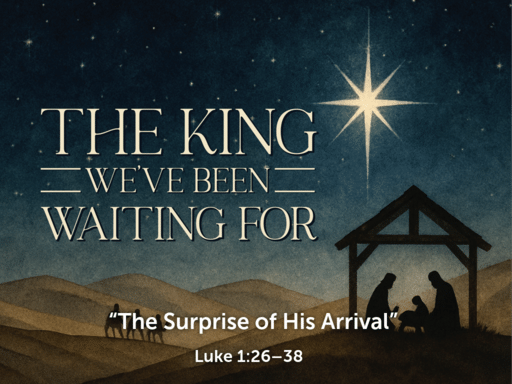
"The Surprise of His Arrival"
Notes
Transcript
I still remember the day Yvette and I were headed to hear our youngest daughter, Lily’s heartbeat for the very first time. It was one of those milestone appointments — the kind where you’re excited, nervous, hopeful, and praying for everything to be normal. We were driving over, and out of nowhere, a thought hit me: “What if there are… twins?”
And I’ve got to tell y’all — that thought did not feel holy. It felt like panic wrapped in fear wrapped in more panic.
Because our whole life was structured around the expectation of having two children total.
Three-bedroom house — perfect fit.
Car with seating for four — tight but doable.
Budget — barely surviving two kids, absolutely not prepared for a third.
Energy level — the Lord did not design us for zone defense.
In a five-second window, my mind took off: “What if we walk in and the doctor says, ‘Surprise! Two heartbeats!’?” We’d need a new car! A new house! A new budget! A new life plan! How much coffee is required for twins? Do they sleep? Do we sleep?
Meanwhile Yvette is sitting peacefully, looking out the window, unaware that I’m spiraling about possibly having two Newburg babies arriving at once.
Why? Because sometimes the mere possibility of an unexpected arrival can jolt your entire sense of stability. And if that moment caught me off guard, Mary’s moment that we just read was infinitely more jarring. What felt like chaos to me was holy calling for her.
Arrival can be surprising. Arrival can be disruptive. Arrival can shake the pieces of your life you thought were in place.
And that’s exactly what happens in Luke 1.
Mary isn’t looking for God. She’s not praying for an angelic encounter. She hasn’t journaled her way into spiritual readiness. She’s simply living her everyday life…and then heaven arrives. Into her home. Into her plans. Into her relationships. Into her future.
If Advent teaches us anything, it’s this: God often arrives when we least expect him. And this is where many of us are living today.
We know God comes with grace…but we don’t feel ready.
We know he steps toward us with purpose…but we feel too wounded to receive it.
We know his calling pushes us into places we can’t navigate without him…but we feel too uncertain to say “yes.”
Some of us walk in today exhausted. Some walk in careful — guarded. Some carry wounds from past church seasons. Some carry grief that gets sharper during holidays. Some carry unspoken fears. Some carry the belief that God shows up for other people — but maybe not for them.
And if we’re honest, when God’s presence, or his conviction, or his calling presses into our lives, it can feel unsettling.
Why? Because God’s arrival always disrupts “normal.” It calls something out of us. It changes something in us. It invites us somewhere new.
So before we move deeper into the story, let’s name the truth: The arrival of Christ doesn’t wait for perfect conditions. He arrives in real lives, in real wounds, and in real fear.
And the question of Luke 1 isn’t simply: “Did Jesus arrive?” The question is: “Am I ready to welcome his arrival?” And on this matter of arrival, we’ll unpack three truths from this passage, with the first being that
God Arrives in Unexpected Places
God Arrives in Unexpected Places
Luke begins the story of Christ’s birth with a detail we are meant to notice immediately:
Luke 1:26 “In the sixth month the angel Gabriel was sent from God to a city of Galilee named Nazareth”
Nazareth was not the kind of place anyone expected God to arrive. It wasn’t a spiritual hotspot. It wasn’t a center of influence. It wasn’t admired or respected. It was a place people passed by without thinking twice.
If you lived in the first century and someone said, “The Messiah is coming,” your mind would go to Jerusalem — the holy city…or Rome — the seat of power…
or even Bethlehem — the city of David.
But Nazareth? That’s like saying, “God is going to change the world… starting in Big Spring.” People would nod politely and think, “Are you sure?” That’s the point. God often arrives where we least expect him.
Then Luke zooms in further — not just to an unexpected place, but to an unexpected person:
Luke 1:27 “to a virgin betrothed to a man whose name was Joseph…And the virgin’s name was Mary.”
Mary is not a princess. She is not a prophet. She is not a priest’s daughter. She’s a teenage girl in a quiet town, planning a normal life: marriage, family, routine, simplicity.
And heaven chooses her. Not because she is powerful. Not because she is prominent. Not because she is perfect.
But because this is how God loves to work. He arrives among the ordinary to do the extraordinary.
God arrives in places people overlook. God arrives in lives people underestimate. God arrives in moments people assume are too small to matter.
This is good news for us. Because if Nazareth wasn’t too small for heaven’s arrival, do you know what else isn’t too small for heaven to show up in? Your life.
My friend, maybe you feel ordinary. Maybe unseen. Maybe overlooked at work. Maybe stretched thin at home. Maybe carrying wounds you don’t talk about. Maybe wondering if God’s arrival happens for other people — the strong ones, the polished ones, the spiritually “better” ones.
But Mary’s story tells us:
God arrives in the homes no one notices.
God arrives in the hearts no one celebrates.
God arrives in the stories no one else would choose.
And when he arrives, he speaks the same word the angel spoke to Mary:
Luke 1:28 “…the Lord is with you!”
Not “against you.” Not “disappointed in you.” Not “waiting for you to get it together.” With you.
Some of you today feel like the last place God would show up. But the arrival of Christ has always been God’s way of saying: “I am willing to step into the most unexpected places — including yours.”
Mary didn’t audition for God. She didn’t apply for this assignment. She didn’t climb her way into God’s attention. God arrived in her life because that’s who he is — and Mary responded with open-hearted surrender. And the same God stands ready to arrive into the places you feel least ready, least worthy, least prepared.
He arrives not because of who we are, but because of who He is.
Now that we’ve seen that God arrives in unexpected places, the next think I want us to see is that
God Arrives With an Unexpected King
God Arrives With an Unexpected King
After Mary hears the greeting, the angel speaks the heart of the message — and it is not about Mary. It is about the child who is coming. The surprise of this arrival is not just that God shows up in Nazareth, or that he shows up to Mary, but that he shows up in the form of a King no one was expecting.
Gabriel begins with reassurance: Luke 1:30 “Do not be afraid, Mary, for you have found favor with God.”
Notice the order. Before Mary is told what will happen, she is told who God is toward her. Not angry. Not distant. Not disappointed. Rather, what? Favor. Grace. Nearness.
Then comes the announcement of the arrival that changes everything: Luke 1:31 “…you will conceive in your womb and bear a son, and you shall call his name Jesus.”
This child will not simply be a blessing. He will be a Savior. Jesus — Yeshua — means “Yahweh saves.” In other words, God’s arrival is not God inspecting our lives. It is God rescuing our lives. And that rescue is not sentimental. It is not seasonal. It is not shallow. It is deep, eternal, soul-level rescue.
Next, Gabriel reveals the identity of this child: Luke 1:32 “He will be great and will be called the Son of the Most High…”
If Mary was surprised that God arrived in Nazareth, this must have taken her breath away. This child is not merely from God — this child is God the Son. This child is not merely from God — this child is God the Son: eternal, not created, of the same divine nature as the Father. The one who spoke creation into existence now speaks from the womb of a young woman in a forgotten village.
Then the angel announces the kingly nature of Jesus: Luke 1:32 “…the Lord God will give to him the throne of his father David.”
This is arrival language. God’s long-promised King has come. The King who will put things right. The King who will bring justice and mercy together. The King who will shepherd his people with compassion and authority.
And then the angel says something no other king can claim: Luke 1:33 “and he will reign over the house of Jacob forever, and of his kingdom there will be no end.”
Earthly kings rise and fall. Markets rise and fall. Oil booms and cools. Leaders come and go. Organizations have strong seasons and fragile seasons.
But when God arrives in Jesus, he arrives with a kingdom that does not wobble.
This is good news for a church like ours. We are doing well, but we are still healing. We have momentum, but we have areas that need strengthening. We have unity, but we also have wounds from the past. And if we were depending on human leadership alone, we would be anxious.
But we are not. We have a King whose reign is steady, whose mercy is steady, whose power is steady.
Here is the surprise woven into this second truth: The arrival of Jesus is the arrival of the true King — the King who saves, the King who rules, the King who does not leave.
He arrives not merely to inspire us, but to rescue us. He arrives not to improve us, but to reign over us in grace. He arrives not to give advice, but to give a kingdom that cannot be shaken.
And his arrival changes everything. So, because God arrives with an unexpected King, there’s also one more thing here. And that is that
God Arrives with an Unexpected Calling
God Arrives with an Unexpected Calling
When Mary hears the angel’s message — the identity of Jesus, the promise of his kingdom, the assurance of God’s favor — her first response is not rebellion or disbelief. It is an honest, human question: Luke 1:34“How will this be, since I am a virgin?”
Now, Mary is not doubting God’s power. She is not resisting his plan. She is simply naming the gap between what she understands and what God has announced.
We know that gap well. It’s the space between God’s Word and our ability to see how it could possibly play out. It’s the space between a calling and the capacity we feel we have. It’s the space between what God asks and what our fears whisper back.
Mary knew a few things very clearly:
She knew she was a virgin.
She knew Nazareth had opinions.
She knew Joseph would have questions.
She knew her reputation might unravel.
She knew her life would never again fit inside the neat plans she had formed.
In other words, Mary knew that God’s arrival in her life would be costly. It would disrupt the predictable. It would reshape her identity, her relationships, her future.
And that’s what often makes us hesitant, too. We like the idea of God arriving — until his arrival moves from comforting to disrupting. Until his calling moves from inspiring to costly.
But notice how the angel responds. He doesn’t give Mary a five-step explanation. He doesn’t give her a detailed roadmap. He gives her something much better: Luke 1:35 “The Holy Spirit will come upon you… For nothing will be impossible with God.” Just as an aside, Father, Son, and Holy Spirit are all present here, working in perfect unity as the one true God.
This is the pattern of God’s arrival. He does not call us into things we can accomplish on our own. He calls us into things that require his power — his presence — his Spirit.
With everything she’s been told, I hope you can see that Mary cannot make this happen. Mary cannot manage this story. Mary cannot engineer this outcome. And neither can we.
God’s arrival always involves a calling that is bigger than our confidence and deeper than our ability. And here’s the thing with God’s calling…it’s not meant to crush us, but do you know what it is meant to do? It’s meant to draw us into dependence.
And then comes one of the most beautiful responses in all of Scripture: Luke 1:38 “Behold, I am the servant of the Lord; let it be to me according to your word.”
Mary still doesn’t fully understand. She still has questions. She still has fears. She still knows the cost.
But she also knows the One who is calling. And knowing him is enough to say yes.
Here is the surprise of this third truth: The arrival of Jesus doesn’t just bring comfort — it brings calling. It doesn’t just offer peace — it requires surrender. It doesn’t just inspire — it invites us into obedience that feels bigger than we are. Mary’s yes becomes the doorway through which salvation enters the world.
Your yes — your surrender, your availability, your obedience — becomes the doorway through which God’s arrival continues to be seen in Midland.
God arrives with an unexpected calling. And the question is not whether the calling feels easy. The question is whether we will surrender to the One who calls.
When we step back and look at Mary’s story, we see a pattern of how God loves to work. He arrives in unexpected places, with an unexpected King, and with an unexpected calling. But Advent is never meant to stay in the first century. This is not just Mary’s story. It is ours. And if we take this seriously, we begin to understand the invitation before us:
Christ arrives where we least expect Him.
Christ arrives where we least expect Him.
Advent is not a season we observe — it is a season that asks something of us. So, when Christ shows up, it’s not in the cleaned-up parts of our lives. Not in the places we feel strongest. Not in the parts we feel most prepared to offer him.
He arrives in the places that feel too ordinary, too wounded, too complicated, too uncertain.
So let’s consider three specific areas where his arrival meets us today.
First,
Christ arrives in our places of uncertainty
Christ arrives in our places of uncertainty
Mary asked, “How will this be?” You and I have our own way of expressing our curiosity with God. For me…it was first, “You can forgive me of that?” Then it was, “You want me to do what?” Then most recently it was, “Midland? Did you mispronounce Honolulu, Lord?”
And maybe for you, you express things with, “Lord, how will I forgive that?” Or, “How will I trust again after what happened?” Or, “How will I step into what you’re calling me to when I feel so small?”
God is not threatened by your questions. He meets honest uncertainty with patient arrival.
Second,
Christ arrives in our places of woundedness
Christ arrives in our places of woundedness
Some in our church are still carrying the weight of past leadership seasons, strained relationships, or previous church wounds. Here’s the thing about those wounds that I’ve discovered. None of them disappear by ignoring them. They just deepen. But the God who arrived in Nazareth is the God who arrives in your pain — not to shame you, but to heal you. He does his best work in places we would rather avoid.
Third,
Christ arrives in our places of calling
Christ arrives in our places of calling
Mary didn’t fully understand her calling, but she surrendered. And that surrender positioned her for God’s work to unfold through her life. In the same way, God may be calling some of you into obedience that feels bigger than you are — ministry, leadership at home, reconciliation with someone who hurt you, service in our church family, reaching a neighbor, or simply trusting him where it feels hardest.
Christ arrives where we least expect him.
The question is not just, “Do I believe that?” The question is, “Will I welcome his arrival?”
We cannot miss the gospel thread woven through this story. Jesus did not arrive simply to inspire us or to give us a holiday season. He arrived to save us. He arrived to carry our sin, to bear our judgment, to conquer our death. He arrived in a manger so he could one day arrive on a cross. He stepped into Mary’s womb so he could one day step out of the tomb — alive, victorious, reigning forever.
This is the wonder of Advent: God in Christ Jesus does not wait for us to climb to him. He arrives to bring himself to us.
He arrives in grace. He arrives in mercy. He arrives in power. He arrives in love.
And friend, he arrives for you.
No matter your past. No matter your wounds. No matter your hesitation. No matter your story.
The King who arrived in Nazareth has arrived for your salvation. Christ arrives where we least expect him. So how do we respond?
First, if you have never surrendered your life to Jesus Christ, today is the day. Not “one day,” not “when I get things together,” not “when life feels calmer.” Jesus Christ, the Savior and King, has arrived for your rescue. Turn from your sin and self-rule. Trust in his saving work alone. Pray, “Lord Jesus, I surrender my life to you. Save me. I am yours.” And if you make that decision today, please come tell one of us at the front after the service. We want to walk with you. If Christ has arrived for you, then today is the day for you to arrive before him.
Second, if you are already a follower of Jesus, identify one place in your life that feels least ready for God and welcome his arrival there. Name the uncertainty. Name the wound. Name the calling. And pray Mary’s words: “I am your servant; let it be according to your word.”
Third, look for where God is arriving in Midland this week — in conversations at work, in needs around you, in the people he places in your path. Don’t assume God only arrives in big moments. Be attentive. Be available. Be surrendered.
Christ arrives where we least expect Him.
Christ arrives where we least expect Him.
And everything changes when we welcome his arrival.
